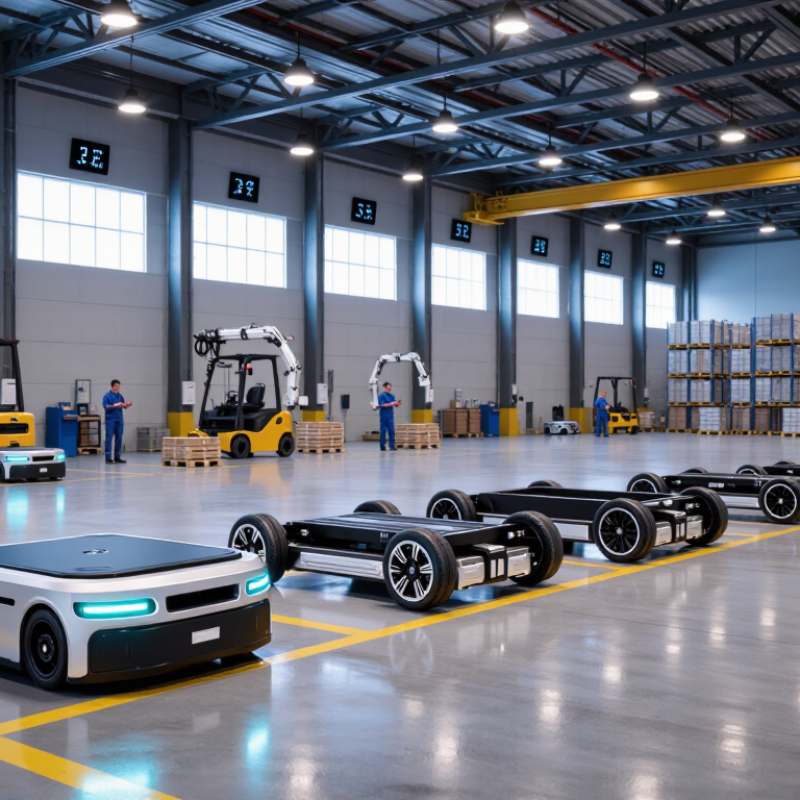
| Chassis Function | Structural platform integrating the drive system, steering or differential motion, battery, controller, safety devices, and mounting interfaces. | The chassis determines the vehicle’s load capacity, stability, serviceability, and compatibility with the upper module. | Choose a modular design with clearly documented mechanical, electrical, and software interfaces. |
| Rated Payload | Common industrial ranges include approximately 100–1,000 kg; heavier platforms may exceed this range. | Payload affects motor sizing, braking distance, frame strength, battery consumption, and floor loading. | Specify payload together with load-center distance, load height, acceleration, and floor conditions. |
| Travel Speed | Typical operating speeds are about 0.5–2.0 m/s, depending on payload, site layout, and safety limits. | Higher speed can improve throughput but generally requires longer stopping distances and more advanced safety control. | Evaluate speed under loaded conditions rather than relying only on the no-load maximum. |
| Navigation Compatibility | Common methods include magnetic tape, QR or visual markers, laser-based navigation, natural-feature navigation, and SLAM-based navigation. | Navigation choice affects installation cost, route flexibility, positioning accuracy, and performance in changing environments. | Select a chassis with an open interface for the required navigation sensors and control software. |
| Drive Configuration | Two-wheel differential drive, four-wheel differential drive, steering-wheel drive, and omnidirectional drive are widely used configurations. | The configuration determines turning radius, maneuverability, traction, maintenance needs, and suitability for narrow aisles. | Match the drive system to aisle width, floor flatness, turning requirements, and desired control accuracy. |
| Positioning Accuracy | Typical docking accuracy is approximately ±10–30 mm, while specialized systems may achieve tighter tolerances in controlled conditions. | Accuracy affects pallet pickup, conveyor transfer, rack alignment, and automated charging. | Verify repeatability at the actual loading point, not only the navigation sensor’s laboratory accuracy. |
| Ground Clearance | Many indoor chassis provide approximately 20–50 mm of ground clearance. | Clearance influences the ability to cross floor joints, ramps, thresholds, and minor surface irregularities. | Measure the site’s smallest clearance point and account for wheel compression under full load. |
| Battery and Operating Time | Operating time commonly ranges from approximately 6–12 hours, depending on battery capacity, duty cycle, payload, and charging strategy. | Battery performance affects fleet availability, charging infrastructure, shift planning, and total operating cost. | Compare usable energy, charging time, battery cycle life, thermal protection, and opportunity-charging support. |
| Safety Architecture | Typical systems include emergency-stop circuits, safety laser scanners, bumpers, warning lights, audible alarms, speed zones, and obstacle detection. | Safety functions reduce collision risk and support safe interaction between vehicles, workers, and infrastructure. | Require documented risk assessment and conformity with applicable safety requirements, including ISO 3691-4 where applicable. |
| Ingress Protection | Indoor chassis often use enclosures around IP20–IP54; the appropriate rating depends on dust, water, and cleaning conditions. | Insufficient protection can cause sensor, controller, connector, and battery failures. | Specify the required IP rating by zone and confirm test documentation for the complete assembled chassis. |
| Control and Integration | Common integration elements include industrial Ethernet, digital I/O, CAN bus, fleet-management interfaces, and programmable motion-control parameters. | Open integration reduces dependence on one control architecture and simplifies connection to warehouse-management or manufacturing systems. | Request interface documentation, communication protocols, software access levels, and cybersecurity provisions. |
| Environmental Conditions | Many indoor AGV chassis are designed for approximately 5–40°C and non-condensing humidity; exact limits vary by component. | Temperature, humidity, dust, vibration, and floor contamination influence reliability and maintenance intervals. | Validate every component against the actual site conditions, including cold storage, washdown, or high-dust areas. |
| Manufacturing Quality | Key controls include incoming inspection, weld quality checks, dimensional inspection, electrical testing, calibration, and end-of-line functional testing. | Consistent manufacturing quality improves repeatability, service life, and fleet-wide compatibility. | Request quality records, inspection plans, traceability procedures, and sample test reports. |
| Serviceability | Replaceable drive wheels, accessible connectors, modular battery compartments, and standardized fasteners support efficient maintenance. | Shorter repair times increase availability and reduce the cost of ownership. | Evaluate preventive-maintenance intervals, spare-parts availability, remote diagnostics, and technical training. |
| Compliance Documentation | Relevant documentation may include risk assessments, electrical schematics, user manuals, test reports, declarations, and component certificates. | Complete documentation supports commissioning, audits, troubleshooting, and safe operation. | Select a manufacturer that provides complete technical files and supports site-specific compliance requirements. |